


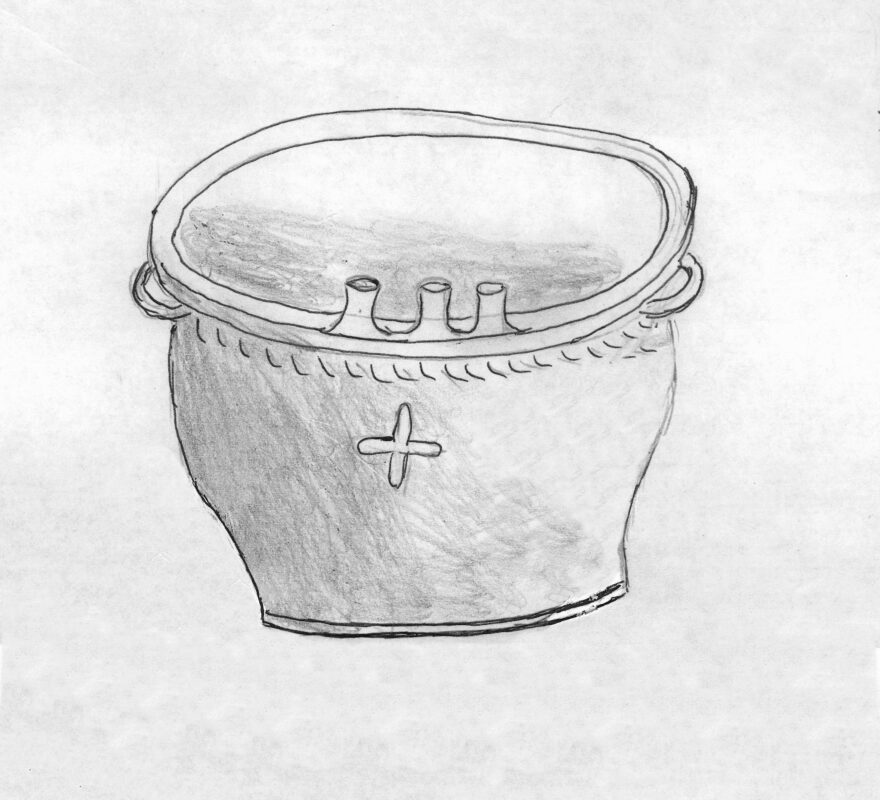
Baptism was and is a sacred and revered bond. Many times two friends, as a seal of their friendship, became cousins. Sometimes, however, there was no lack of calculation and purpose. Often, as is still the case today, they preferred to have a political figure in order to benefit from his influence. Many times, the shepherds sought, through syntekniá (spiritual kinship), to gain access to the thieves’ circles—both so that the thieves would “show them respect” and so they could “declare” their flocks in case they were stolen. Relevant to this is the following rizitiko song:
If you wish to go up to Omalos and be respected,
make a Lakkiotis your synteknos (spiritual kin),
a Sfakian your koumbaros (best man),
an Agioriniotis your sworn brother,
and a Panohoritis your friend—
then you’ll surely go to Omalos with honor.
Back in those days, livestock theft was “boiling over.”
In Omalós, the thieves from the villages mentioned in the song held sway,
and if someone wanted to bring their sheep there,
they had to secure a kind of “protection” or recognition from those very thieves.
Yet often, through the forging of syntékniés (godparent ties),
disputes were bridged, and unforeseen consequences were avoided.
After pressure and pleas from peacemaking figures,
it was not uncommon for deep hatred to be replaced by a sacred bond—
the bond of godparenthood (syntékniá), which could turn sworn enemies into kin.
When the child was baptized and became a little Christian,
may his parents rejoice and raise him well,
and send him off to school so he may learn his letters.
May the godfather also rejoice, and one day crown him in marriage,
and baptize his child in turn.
The syntékno (godfather) would gather 15–20 men and head off to perform the baptism. He would choose, among his friends and kin, the good singers, the heavy drinkers, the dancers—in general, those who would make him proud, because even the baptism was a kind of friendly contest between the two groups. They would arrive at the church by nightfall. There, the child would be brought to be baptized. The parents of the child would not go to the church. When the baptism was over and they returned to the house, the mother of the child would stand at the door and receive the child from the hands of the godfather, whose hand she would kiss. Once the table was set, the godfather’s group would begin the singing:
My godchild, on your wedding day and in your joyful celebration,
may the snows turn into flour, and the mountains into rams,
the sea into sweet wine, and the ships into cups,
so that all your guests may drink their fill.
It was once a custom for the “sántoulos” (godfather) to officiate at the wedding of his filiótso (godchild), and also to baptize his godchild’s first-born. This song wishes for that full circle to be completed. Another baptism song from the godfather’s group goes as follows:
Shall I say it or shall you — the song of the table?
For the table longs for it, and the company calls for it,
and the master of the house holds secret pride
when the song of the bench is sung.
On Saturday the godfathers (sýnteknoi) would arrive, and on Monday they would depart. They were hosted at the homes of relatives and neighbors — in small villages, at every house. When they left, each was given a towel and a patitó (a pressed sweet or baked good), while the first godfather (proto-sýntekno) also received a sack with a gift. Farewells were sung with one of the two traditional parting songs already mentioned. What followed were feast table songs (távla), sung in every gathering, often beginning with a traditional verse as soon as the guests sat down to eat.
A thousand greetings we offer to our dear friend’s home,
To the friend, our sýnteknos (or our koumparos or sympetheros)
Our truest, closest friend — may time treat him well,
And may no hardship ever come, so we may return with joy again.
When the group is united, the rizitiko can be sung by one or two, and the others join in. When the host’s group sits on one side and the guests on the other, one group begins and the other picks it up. It’s customary to start with half a mantinada, then sing the rizitiko, and upon finishing, to close with another mantinada by the same person. A visiting group may begin with the following song:
Why do you all sit around so heavy-hearted,
not eating, not drinking, not rejoicing?
Before Death comes to find us and sweep us away,
to sweep away generations, to pick out the men,
to take the brave men, the castle-breakers.
How the verses alternate is described in another section of the text. When the singing pauses for a moment, someone may reignite the spirit by saying:
I see our table, and it is well set—
with fragrances and sweets and cypresses adorned.
The sugar is the wine, the bread is the fragrance,
and the brave young men on the benches are the cypresses.
Also, at the beginning of the celebration, when it is not a special occasion that requires its own specific song, once the table is set, the following song may be sung:
It is not fitting for me to sing, nor even to drink wine,
but in a dark little cave to shed black tears,
for my heart is black, darkened and heavy—
Death has turned it black.
When someone was in recent mourning, they would sing the following song:
Christ, if only youth could take three steps back,
that I might become again the brave young man I was—
to grab my rifle and climb to the Madares,
so all would make way wherever I pass.
Also sung by an elder (and not only):
Golden world, silver world, world of beaten gold,
O world, who has conquered you—and who ever will?
World, I feasted on your joys, yet I shall never win you.
On foot I toiled the mountain peaks, on horseback rode the plains.
From the elders, this song is sung:
“I grafted you myself, and I’ll give you to no other,
and the water I promised you I’ll waste on no other tree.”
In the old days, if a young woman became a widow, she was expected to “honor the memory” of her deceased husband and not remarry. Even a fiancée, if she lost her betrothed, would often “hold true to his memory.” During the Daskalogiannis Rebellion, a man named Pavlos Zampetis from Anopoli was killed—he was engaged to a young woman from the Patakos family. In a mourning lament, the girl’s mother promised the dead man that she would never marry her daughter to another groom.
Oh you, who have come down from the world above,
come, rest a while — I wish to ask you something.
Tell me, does the sky still stand, does the world above still hold?
Do they still baptize children, do they still build monasteries,
and do widowed women marry brave young men again?
The following song is related to the “favor” or devotion that widows keep for their deceased husbands.
Mother, if our friends come, if our own kin arrive,
do not tell them I have died, lest you weigh heavy on their hearts.
Set the table for them to dine, and a bed for them to rest,
lay out a side bench for them to place their arms.
And when morning comes and they rise to bid you farewell,
then tell them that I have passed away.
Hospitality used to be held in greater respect in the past than it is today:
A curse upon the one who envied vineyards or orchards—
as for me, I envy my own when they divide their land,
especially when they are brothers or first cousins,
or uncle and nephew.
Today, most people say, “Once I’m gone, let the sun never rise again,” but back then, even on his deathbed, a dying man still held hospitality in high regard.
Don’t weep for the brave man, even if he misses his mark —
Even if he fails once or twice, he’s still a man of valor.
His doors are always open, his table always set,
And friends come and go as they please.
Family unity has always been valuable, but in the past, the way of life was such that everyone truly depended on that unity.
The weapons of brave men should never be sold—
they should be polished and hung upon the wall,
so that other young men may look upon them with pride
and remember those who bore them.
This song tells us that as long as someone is strong and courageous, they do not bend in the face of life’s hardships. It honors the resilience and dignity of the brave, reminding us that true strength is not the absence of failure, but the ability to stand tall despite it.
The basil plants give off their scent, and so do the sweet marjoram,
but none can match the fragrance of a wise and noble soul.
Not marjoram nor basil, nor little carnations bloom—
fragrance follows where he sits,
fragrance lingers where he stands,
fragrance flows where he walks.
When brave young men die, their name does not die with them.
There’s nothing else I cherish in this world above
like a horse in noble stride, a galley as it races,
and a man who holds his head up high,
who takes no insults and deals no wrongs.
This song tells us that moral values are priceless.
Far off in the distant quarter, down the furthest street,
two young women cry in pain—one wealthy, one poor.
At the rich one’s door they come and go, a hundred midwives,
but at the poor girl’s side stand only the HolyMary and her Son.
The rich girl gives birth and bears a child with a poisoned heart.
The poor girl gives birth and bears a child full of grace.
They take the poor girl’s child and give it to the rich one—
but on the third day the baby speaks:
“Take me back to my mother so I may nurse sweetly at her breast.”
This too speaks of virtue and integrity.
This song denounces injustice, highlighting how truth and worth can’t be stolen or replaced—even when the poor have no one but God beside them.
who met upon the steps of Hades.
“Rich man, where are your riches now,
where are all your treasures?
and where are your palaces?”
Listen to a conversation between a poor man and a rich man.
These are the blessed days, these are the joyful weeks,
when each one calls upon his friend, awaits his own dear ones.
And he who has a love far away writes and sends a letter,
and fills it with the words of his heart.
Vanity of vanities.
Leave aside your worries and your bitter thoughts,
come now that we’ve gathered to eat and to drink,
and let us rejoice and celebrate the days we live—
before Death comes to find us and carry us away.
This song was traditionally sung at celebrations held on festive days.
Sometimes, during a lull in the singing, a conversation might start up.
But someone from the company, with this little song,
“brings everyone back to order.”