


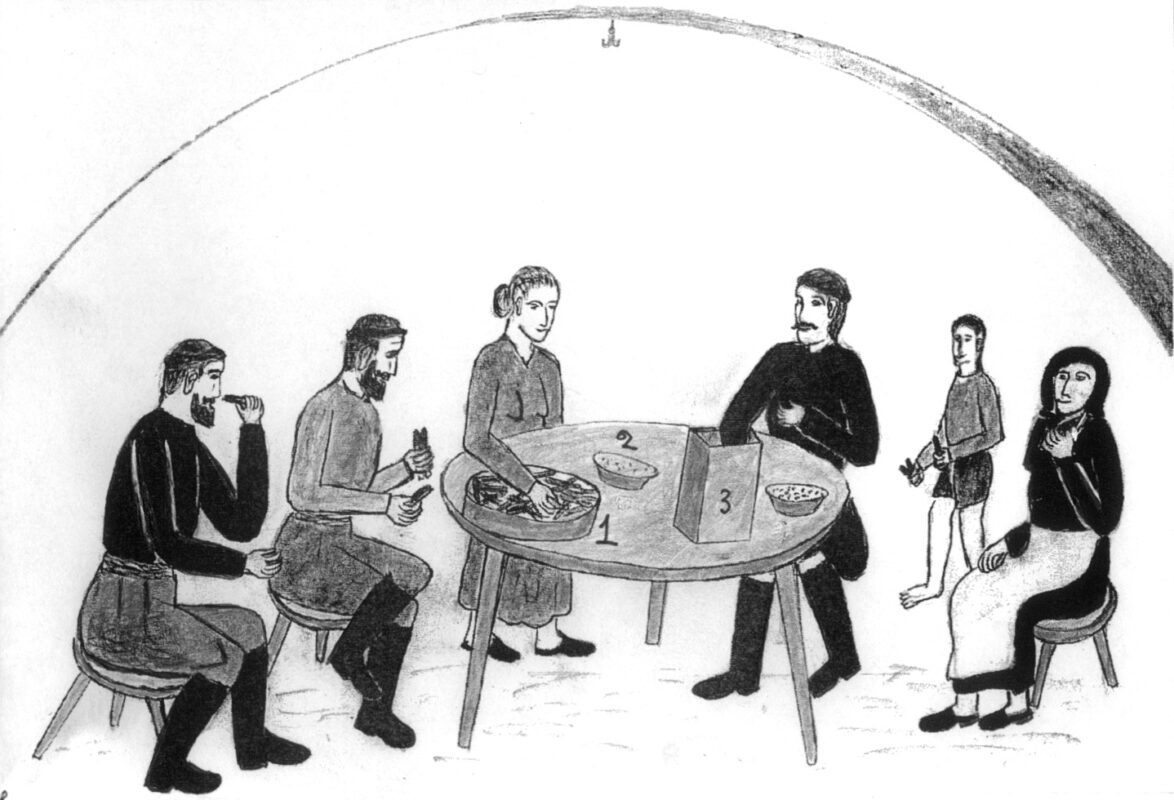
Often, a message was conveyed through the mantinada during a feast. In a way, it served as a form of mass communication within the group, but at times it also carried broader messages—especially in an era without radios or televisions, and when people, particularly in rural areas, rarely read newspapers. More than anything, it was through song—and especially through rizitika—that messages were transmitted, instructions were given, history was recorded. One specific category of these songs (the so-called allegorical ones) was intentionally crafted to uplift the morale and hope of the enslaved nation. These songs contained elements that the intended recipient could understand, but also misleading elements meant to deceive any unwanted listener, as Turks would often intrude uninvited into the gatherings of Christians. I present here a few examples as they were explained to me by people who lived through those times—Andreas Boliotis, a lawyer; Andreas Zervos, also a lawyer; Panagiotis Klados, a vehicle operator; and the then very elderly Manousos Kagiavtakis. I believe that allegorical songs deserve thorough study, and to this day, I have not seen anyone give them the attention they truly merit.
Christ, if only the dream I saw tonight would come undone—
I saw my beloved as a hunter, my husband as a wild beast.
Christ, if only the hunter would slay the wild beast,
so I could take from his blood to dye my hair,
and eat from his liver so my own pain would heal.
In this verse, the folk poet likens Crete to a young woman who has been forcibly taken as a wife by someone (Turkey), while her heart belongs to another (Greece). Χριστέ και να σκότωνε ο “κυνηγός ( η Ελλάδα) το “αγρίμι” (την Τουρκία). So vividly is the mortal hatred portrayed.
On a high mountain, on a rugged cliff,
sits an eagle, soaked and snow-covered,
and he pleads for the sun to rise:
“Sun, rise up, shine and give your light,
so the snow may melt from my wings
and the crystals from my fingertips.”
In this song, the folk poet calls upon freedom, but he names it “sun.” When he says “snow on the wings” and “crystals on the fingertips,” he is referring to the unbearable hardships of slavery.
My wild ones and little wildlings, my gentle deer,
tell me where your lands are and where your winter shelters lie.
“Our lands are the cliffs, our shelters the caves,
the little mountain caverns, our ancestral homes.”
This song vividly portrays the hainides — the freedom fighters, the rebels of Crete.
Eagle, you who sit high upon the snowy mountain,
you feed on the dew of the snow, you drink the icy water,
if you catch a hare, you savor it, a partridge, you dine on it,
and you kiss a beautiful maiden.
As things stand today, there are equal conditions across the land for everyone to enjoy the blessings of life. During the Ottoman occupation, however, only those who lived far from the presence of the Turks could enjoy the blessings of life—even if it was a fragile and anxious kind of freedom. “They fed on the dew of the snow, and if they caught a hare, they savored it” (meaning they enjoyed the fruits of their labor). And when he says “you kiss a beautiful maiden,” he means that you breathe the air of freedom and enjoy the blessings that freedom offers.
An eagle caught a partridge and gently asked her:
“My partridge, may you live long — where do you build your nest?
Where do you lay your eggs and raise your little ones?”
“Take me softly in your claws, eagle, and I will tell you:
Do you see that mountain there, the one beyond, far yonder?
And even farther beyond it? There, at the mountain’s foot,
upon a rugged rock, there grows a little thyme bush.
At the root of that thyme bush I made my nest,
I laid my eggs and hatched my chicks,
but the chicks have now fledged and flown away.”
Here, the message conveyed is that when someone is under great pressure, they should offer vague or misleading information — details that cannot be truly exploited.
Go out and cry aloud in Lakkoi and in Orthouni,
so that the sons of Lampathis and of Bimbostamatis may come.
And I have set a hare in place to give them the message—
but let them not think it’s truly a hare and gather their hounds!
It is a beast with three heads,
and each head bears double rows of teeth.
A message that a large enemy force has appeared.
My fate has exiled me to forested woods,
down by the Black Sea, in the fine place of Kalamionas,
where beasts roam and dwell,
where the snakes are hairy and the bears have their dens,
and they have double heads and two pairs of eyes.
Many Cretans fought outside of Crete, particularly in the Danubian Principalities. At the beginning of the 1821 Revolution, in a battle that took place in Galați, Wallachia, more than 150 Cretans took part, led by Georgios Daimonakis from Kallikratis. Many of them fell there, including their leader. The above song allegorically describes the tragic moments and dangers they faced in that battle.
Mother, even if you are my mother, and I am your child,
send me my arrows — my very best ones.
For I can do no otherwise, nor can I find peace,
unless I strike down the beast.
It is clear that the “beast” refers to the conqueror. It is known that during the “Cretan War,” the Cretans used bows, and even after the Turks prevailed, they continued to do so for several years. Some allegorical songs may not have had an obvious or specific theme, but their purpose was to keep the flame alive — to preserve hope, unity, and the spirit of resistance within the hearts of the people. In general, rizitika songs, after various edits and reinterpretations over time, are found in two, three, or even four different variations each. I recorded one variation of each, the one I considered the best and most authentic. Many rizitika songs are sung with two different meanings or purposes. Many others are sung with a different purpose in Sfakia and another in the mountainous region of Kydonia.