


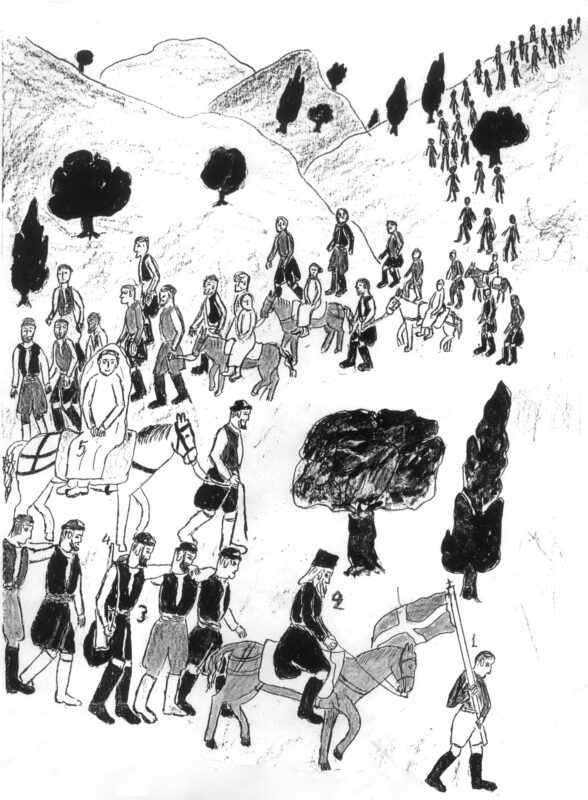
Small weddings used to last three days. Large weddings would last a whole week. It was almost a rule that weddings took place on Sundays. On Friday, relatives and friends from afar would arrive. On Saturday, the best men and musicians would arrive. Many times, the bride was taken as a “symprouki” (bride accompanied by a close female relative) on Sunday. Other times, the groom would send around ten men with their animals on Saturday to bring the dowry. At the bride’s house, they would be treated to a feast, given a patitó (a traditional baked sweet), take the dowry, and leave with the special wedding road song:
We took the dowry, beautifully adorned,
Sixty were decorated, and a hundred and two were braided,
And on them was painted the sky with stars,
The golden sun, the shimmering moon.
Blessed be the hands that adorned them so finely,
And may they bring good fortune to the home they will enter.
At the groom’s house, wooden beams hung from the rafters, and the dowry items were spread out “to be seen.” The person who laid them out had to be a “manokiroudatos”—
meaning both his mother and father were still alive, to bring good luck and blessings.
Give us, mother, your blessing so the wedding may begin.
“My blessing goes before you and behind you,
to your left and to your right.
Go and bring me my child’s bride—
may she come from a good family and pure lineage.”
On Sunday, they would sit at the table to eat, then prepare to go fetch the bride. For the men, there was no limit — whoever wanted to go, went. But for the women, there had to be 11 to 15. The number had to be odd going out and even coming back with the bride. The women who went to accompany the bride were called synopártouses (“companions”). Each synopártousa had to ride a horse or mule, and each had to have her kavaliéro — a trusted relative who led the animal by the reins.
The wedding procession was ready to start. At the front was the child carrying the flag, followed by the priest. Next came the singers, grouped in threes or fours, linked arm in arm. The first would sing a verse, and the others would pick it up. They sought the mother’s blessing with the traditional road song:
A maiden appeared in the East and sang,
But the whistle of the mast and the clatter of the horseshoe,
And the nightingale’s song of the young girl soared to the skies.
The ship captain grasped it amid the open sea,
“Row, sailors, row the oars; helmsmen, steer the helm,
Let us hear what song the young maiden sings.
— “Why do you grieve and sing so sadly, maiden?”
— “In my song, I mourn, too;
I buried my mother and father, brothers and cousins,
And my husband was taken from me, a drunkard,
A vagabond who asked for things this land could not give:
The wild goat’s cheese and the hare’s milk,
Apples from the East, quince from the West,
And so I might catch the hare and milk the wild goat,
To travel East and return from the West.
She grew ill, weakened, and another woman took him.
Along the route, in the groom’s village, the bride’s village, and any villages in between, friends and relatives from both families would come out with drinks and appetizers, hosting the entire wedding party. On the way there and back, they would sing various songs—those traditionally sung on the road for any occasion but with this particular purpose in mind. We will mention a few of these songs.
A maiden wove a ribbon for a year and five months,
Fifteen Fridays and eighteen Wednesdays,
Within her weaving, the sky, the stars, and the moon.
Within she wove the sea and all its ships,
Within she wove Venice with all its treasures,
Within she wove her husband hanging from the gallows,
Within she wove her beloved on horseback.
A maiden and a youth were resting in a quiet orchard,
And after playing and laughing, and all the sweet flirtations,
The youth slowly fell asleep in the young girl’s arms.
Softly, gently, she wakes him and whispers,
“Wake up, my little turtledove, wake up, my sweet love.”
Maiden with curly red hair, and black curly eyes,
Watch your pigeons so they don’t come into my yards,
They eat the wheat I sow, and drink the water I give,
And with their little feet, they scatter my soil all around.
He saddled his black horse to ride down his road. With no one else left to talk to, he spoke softly to his steed, his swift black companion who had saved him from many storms before and whom he hoped would save him once again. Promising to craft golden horseshoes, silver rings, and horseshoe brooches for it, he recalled a little bird he kept in a cage, adorned with laurel branches and fed with sugar and musk. But overwhelmed by the musk and sugar, the bird grew angry, broke free from its cage, and flew away singing in a stranger’s garden.
You send for me, my daughter, and I am coming—
but what shall I wear on my way to you?
“If it rains, wear your woolen clothes,
and if it snows, your white ones.
And if the sky is overcast, wear your velvet garments.
But choose your time wisely, my dear unripe one,
come when the weather is fair — in the month of the Holy Cross,
when the rivers have run dry and the roads are clear.”
When the wedding day was drawing near at the bride’s house,
they could sing the following song:
The young groom sent word to his father-in-law:
“Know this, dear father-in-law — on Sunday I shall come.
Sweep clean the courtyards, whitewash the roads,
for your young groom is coming — go out to welcome him.”
As they approached the bride’s house, they could also sing the following song.
(It is worth noting that the songs sung while walking were called songs of the road and were sung for their own special purpose.)
When they came close to the bride’s home, two or three young men would compete, riding their animals, to see who would arrive first. The one who reached the house first received as a prize a handkerchief from the bride, called a tzevré, which he tied proudly to the mane of his horse.
In the courtyard, the bride’s family awaited them with drinks and appetizers for the welcoming treat. If the wedding party came from another village, tables were set for them so they could be properly hosted. If they were from the same village, no tables were laid, but refreshments were served continuously.
We should explain that back then, tables were set both for seating the guests and for placing the food. For this reason, when people sat down to eat, they would say they were sitting at the table, and the songs sung during the meal were called the songs of the table (tsis tavlas ta tragoudia).
Bid farewell, my bride, to all your kin—
but first to your parents and your dear siblings,
and then to all your girlfriends and your neighbors too.
The crowning ceremony usually took place at the bride’s house. Honey and crushed walnuts were placed on a plate, and after the crowning, a portion was offered first to the newlyweds, then to the best man, and afterward to the rest of the guests.
Once the ceremony was completed, preparations were made for the departure. Accompanying the bride were two or three of her close relatives who escorted her to her new home — they were called the proukia. They would stay there for a few hours to assist and then return home. As a token of gratitude, the bride offered each of them a towel as a gift.
Then, with the traditional road song suited to the moment, the wedding procession would set off:
We took the partridge, rich in every grace,
and left the neighborhood as though it had been plundered.
Next came another road song suitable for the occasion.
Come forth, mother of the groom, and mother-in-law of the bride,
to see your precious son and your golden bride—
welcome your daughter-in-law, your son’s beloved wife.
When there were two roads, the wedding procession preferred the right one. And because what was right upon arrival became left upon departure, and vice versa, coming and going from different directions, we said they were making “the bride’s coil.” If two weddings met on the road, the brides had to throw mud at each other—otherwise, it was bad luck. As the wedding procession moved forward, it was a spectacular sight from afar: white, red, and black animals; various colors from the dresses of the synopártouses; blue trousers, red silk belts, white, red, and black boots worn by the men;
and the long, masculine melody of the road cutting through mountains and gorges. No one will ever see such a spectacle alive again. When they approached the groom’s house, they would sing once more the fitting song for the occasion:
The waters flow, the fountains flow—run!
Run, noblemen, run to see the wedding,
and noble ladies, hurry to see the bride—
how they bathe her and how they comb her hair.
Christ and my Virgin Mary, what a beautiful company,
The sun is the groom and the moon the bride,
And the stars of the sky are the best men,
While the other stars of the heavens are the guests.
Today everyone rejoices, it’s a great celebration,
Today the eagle crowned the partridge,
May they live, be steadfast, and be happy,
And may the company be well too.
The mother-in-law would stand at the door. If she was dressed in black, she would cover her head with a white cloth for the occasion. The bride and the mother-in-law would embrace and exchange kisses. The bride was given a black-handled knife, with which she made the sign of the cross on the door’s lintel. She was also handed a pomegranate, which she threw forcefully onto the floor so it would scatter — a symbolic wish for her to be as fruitful as the pomegranate.
In a prominent spot, the place where the newlyweds would sit was decorated with garlands made of bramble or rose branches. This area was called the pastó (from ancient Greek pastós = bridal chamber). As soon as the bride sat down, they placed a little boy on her lap — a wish that her first child would be a son.
As mentioned, large weddings would last an entire week. Some guests would leave to sleep while others would arrive. Of the newlyweds, at least one had to remain in the pastó at all times. If both happened to leave at the same time, it would be considered disrespectful to their guests.
The antigamos or antichara referred to the visit when the bride’s family came for the first time to see her after the wedding. This could happen later, but sometimes it took place on the very day of the wedding, when several of her relatives would arrive bringing a slaughtered sheep and a demijohn of wine. They would stay for two or three hours and then depart.
In the room where the newlyweds sat, the best man, bridesmaids, and close companions would also sit, along with as many guests as the space allowed. Others were seated in separate rooms, and if the weather did not permit sitting outdoors, tables were arranged inside or even in nearby houses.
Songs that were sung at the start of the wedding celebration included:
Now at the rising of the day, three rivers begin to flow—
one runs to the south, another to the west,
and the finest one of all goes forth to water a garden.
It waters trees and apple trees, apple trees and cypresses,
but there is one sweet apple tree it cannot reach to water.
The celebration continued with songs of the table, those sung in every gathering along with mantinades. Some of these songs will be mentioned on the following pages. When the wedding ended, each wedding guest received a patitó (a special gift or token). The bride gave a towel to her close relatives. The best men also received a patitó and a towel. The chief best man received a sack with a portion of meat and good provisions. The best men, leaving as an organized group, bid farewell with a traditional road song. They might sing “Farewell, high mountains…” as mentioned earlier, but the following song is also suitable: